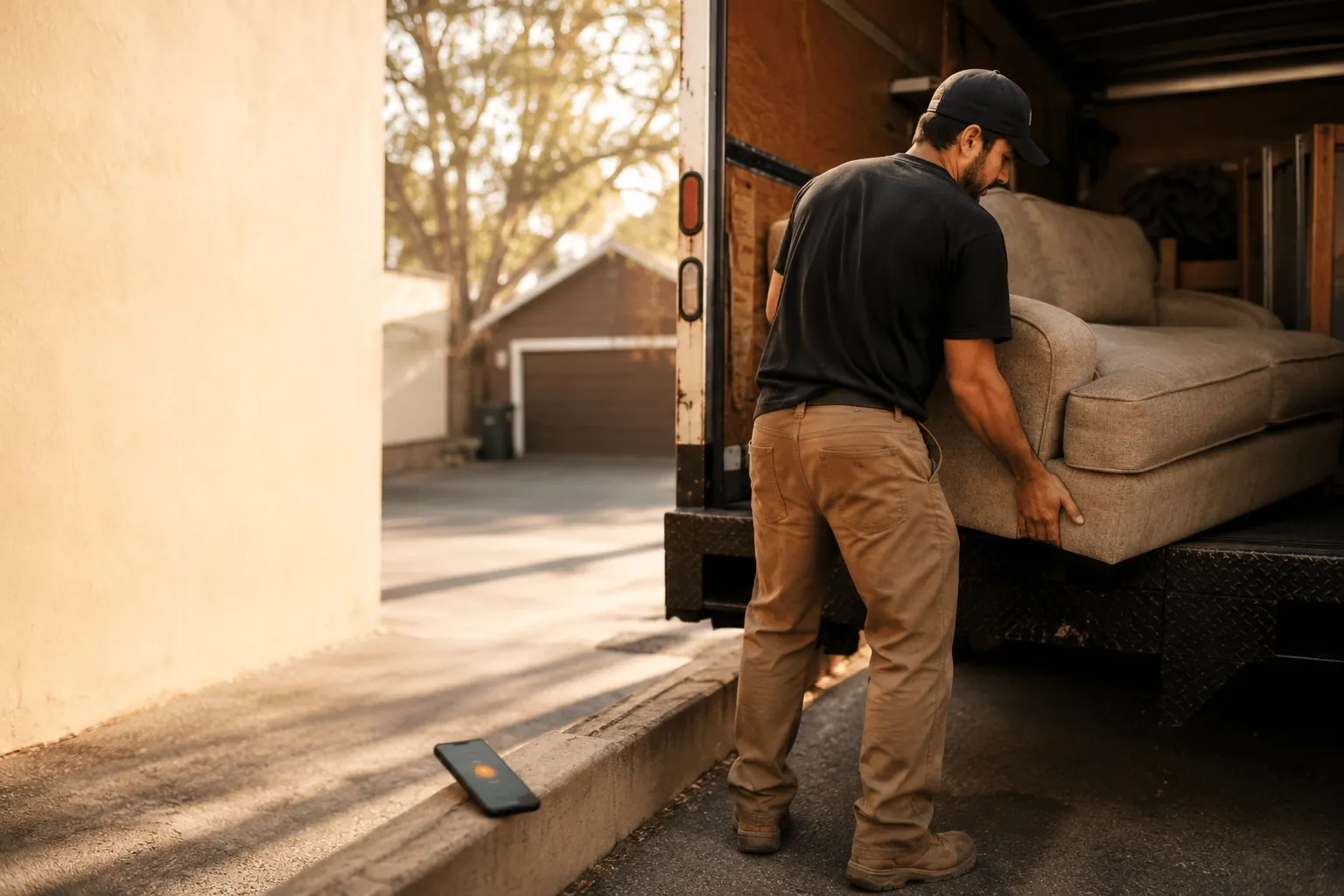
You are on a driveway, backing the truck up to a garage packed to the rafters. Both hands are on a busted dresser. The phone buzzes in your pocket. You cannot drop the dresser on your foot to grab it, so it rings out.
That call was a job. Maybe a good one. And here is the strange part. The owner who keeps answering does not win because he is better with a phone. He wins because almost nobody else bothers.
The line owners keep hearing
Take one part-time junk removal owner in Washington, whose story was written up after an UpFlip interview. He started in 2020. He is not a big franchise. He is one guy with a truck who figured out something simple.
Here is how he puts it: “Answering your phone and answering your email is a huge deal in business. You’d be surprised how many customers we go to that say, ‘You’re the only person who would call us back.’”
Read that line again: not the cheapest, not the fanciest truck, just the only one who called back. He hears it so often that it has become the line he repeats to other owners. A second write-up of the same interview repeats the customer quote as “You’re the only one who called back.”
That is a low bar. And most of the competition is not clearing it.
Most haulers are not answering
One junk removal industry page makes a blunt claim: “about 65 percent of all junk removal business and junk removal franchise owners consistently do not answer their phone.” Treat that as a vendor figure, not gospel, since it comes from a page selling call handling. But anyone who has called around for a quote knows the shape is right. You ring three haulers and one answers.
The same page describes what the customer does next. They “are going to hang up the phone and go down to option #2 on Google.” That is the whole transaction: no second try, no voicemail, just a dial to the next name on the list.
A missed call rarely waits around for a callback. It turns into someone else’s job fast, and by the time you wipe your hands and dial back, the dresser is already loaded on their truck.
Why this hurts more than it looks
One vendor that tracks missed calls runs the math out loud: “At an average job value of $800, that is $7,200 in revenue handed directly to the competition in just 30 days.” That is their example, not a measured fact about your shop, and a smaller load is worth less. But the idea lands. A few missed calls a week stacks up into real money by month end.
That same Washington owner has his own floor for what a job is worth: “I don’t leave the house unless I’m making $200 an hour.” So every call that rings out costs more than it looks like: a paid hour walking down the street to whoever picked up instead.
And it stings worse when you paid to make that phone ring. He burned a fortune on ads with nothing to show, in the same write-up: “We’ve spent at least $60,000 since we started and absolutely no ROI, no return on our investment whatsoever. Ridiculous.” Spend to get the lead, then miss the call, and you have paid twice to lose the same job. If shared lead platforms are part of your spend, we get into that in why shared leads keep losing.
You cannot just answer faster
The honest part is that “pick up the phone” is not real advice for a one-truck operation. You are on a load. Your hands are full of someone’s old couch. You are not ignoring the phone. You physically cannot get to it.
Hiring a person to sit by the phone all day does not pencil out at this size. So most owners just live with the leak. They answer when they can, call back at night, and quietly lose the rest. That is exactly the gap the winners walk into. They win jobs by doing the thing their competitors could not be bothered to do.
Catch the lead without dropping the couch
There is a better answer, and it does not ask you to stop mid-load. SvarKlar is built to catch the lead the second it lands, so the couch in your hands stays the only thing you are touching.
Here is what it does. SvarKlar replies to texts, web-form leads, and direct messages in seconds, any hour. And when a call rings out, it texts that caller right back while they still have the phone in their hand. A fast text means they never get to the next name on Google. We can set that up to run on your own leads.
From there it does the front-desk work. It asks the caller what they need hauled, where, and how soon, so the owner is not starting cold. It books the job or sets a clear callback. If a lead is urgent or unclear, it hands it straight to the owner with the full story, not a shrug. There is more on the speed side in how fast to reply to leads, and the whole idea is laid out in what is an AI receptionist.
The emergency cleanout is the one you really miss
Some of the best work comes with a deadline. An eviction with the dumpster booked for Friday. A foreclosure cleanout the bank needs done. A flooded basement. Those callers are not shopping around for fun. They need an answer now, and they call until someone gives them one.
Miss that call and you do not just lose one job. You lose the property manager who would have called you for the next ten. That whole problem gets its own page: emergency cleanout leads.
But will a robot lose me the job?
Fair worry. A clumsy bot that promises a truck today when that is not true, or talks like a stiff script, can do more harm than a missed call. Some folks already feel burned by leads that seemed fake or churned out by a machine. That distrust is real.
Two things keep it from biting. First, SvarKlar replies by text in the owner’s own voice, not a robot reading a phone script. Second, it knows when to stop. Anything urgent or off-script goes to the owner with the context, so a person closes the jobs that need a person. People still ask about price up front, and there is a clean way to handle that without being chained to the phone, which we cover in handling price questions without the phone.
How SvarKlar is set up
This is not big software you fight with for six months. A real person, Fred, builds each one by hand and runs it himself, and he would set yours up the same way. No enterprise onboarding. No contract you cannot get out of. It gets tuned to how junk work actually comes in: the photo of the pile, the same-day question, the cleanout with a hard date.
That is the underdog version of this. One person who sets it up, tunes it to the owner’s voice, and stays on the hook for it. For the broader picture across the trade, start at the junk removal hub or read up on the AI receptionist.
The job goes to the one who gets back to the customer. Owners build whole businesses on that one habit. And here is the part most owners miss: you do not have to be the one holding the phone to be the one who answers first.
Customers keep telling owners they are the only one who called back, and that says less about service than about how low the bar has fallen, and how much work sits there for whoever clears it.
Want to see how it would catch the calls you miss on a load? Book a call or see how the service works.
More guides like this are collected in SvarKlar Resources.