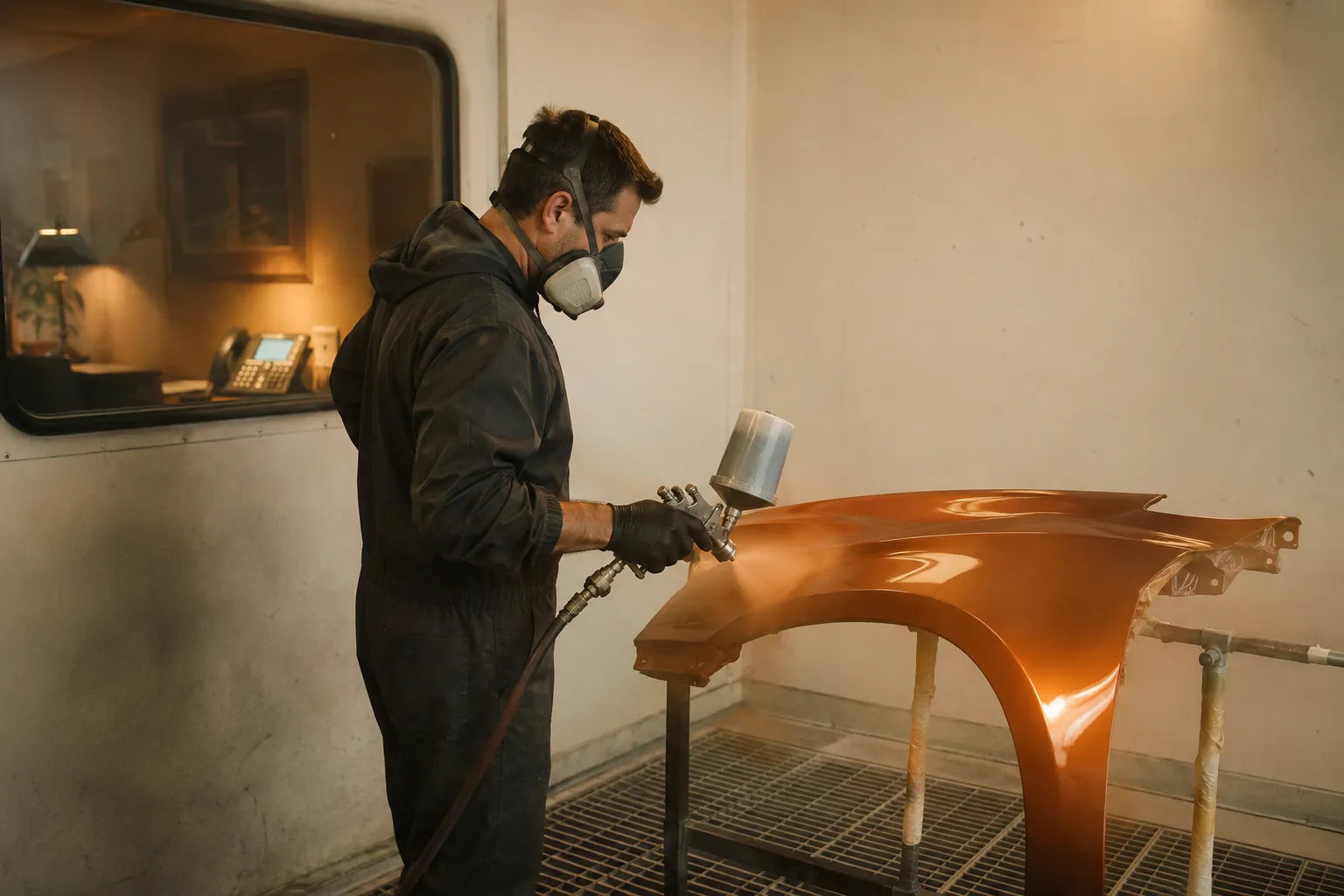
You are in the booth with a respirator on and a gun in your hand. The phone up front rings. You cannot break the coat to answer it, so it rings out. By the time you pull the mask off, the caller is already on the line with the shop down the road.
That call was not a quick question. In collision work, it almost never is. It was a wrecked bumper, a caved door, a hood that needs blending. The job behind it is real money. And it just walked.
A collision lead is a high-ticket job
Most owners feel a missed call as a small annoyance. It is not.
Think about what a collision call actually is. A fender that needs paint-matching, a quarter panel replacement, a cracked windshield after hail. Some jobs stay under a thousand dollars. Others turn into a full teardown once you find the damage hiding behind the panel. Either way, it is a real repair ticket.
So the lead you missed is not a quick oil change. It is the kind of job that makes or breaks a slow week.
One caller, then gone
And the caller does not wait for you.
Most people whose call goes unanswered do not try again. They ring a competitor right away. The shape is the same in every telling. Whoever answers first has the much better shot at the job.
The customer side backs it up. Body shops collect complaint after complaint about exactly this. One customer wrote in a complaint, “every time I call I get a voicemail or his employees say they dont know and he isnt there.” Another, after a promised callback never came, wrote: “No phone call on Monday... Today is Wednesday and I am still waiting to receive the call I was supposed to receive Monday!” Even a large chain is not immune. A Caliber Collision customer reported, “I received no follow-up... The employee said he would call me back. He did not.”
Every one of those started as a real repair lead. It ended as a one-star review.
The first call is the whole sale
The job does not start when the car rolls in. It starts on that first ring.
On the BodyShop Leaders Podcast, longtime collision consultant Jim Lovejoy walks through what a real sales process looks like, from the first phone call all the way through follow-up. His verdict on how most shops handle that first touch is blunt. The line he hears, shop after shop, is “Let us know if we can help you.” As the show puts it, that is not a closing attempt. It is not even close.
The same episode makes a point worth keeping. Follow-up alone lifts a shop's close rate, so the lead you do catch is worth even more if someone actually chases it. Most shops never do.
An auto repair owner, Chris Shamis of Dakota Ridge Auto, said it from the other trade but it fits collision just as well. When a caller cannot get a clear, confident answer, “they might say, ‘OK, I'll call you back,’” and “next thing you know, you've lost that opportunity with that customer.” A nearby trade, same lesson. Handle the first call well or lose the job.
Why your best leads are the ones you cannot answer
Think about when these calls actually land.
You are spraying, sanding, on the phone with an adjuster, or three cars deep on an estimate. The front desk is empty because you are the front desk. Owner-operators wear every hat, tech, painter, estimator, and the one taking the call. One of those hats always drops. In collision, the call is the one that drops, because the work in front of you cannot pause.
That is not a rare setup. Plenty of collision shops are one person who opened a single bay and does every job himself. When the owner is the painter and the painter is the only one there, the ringing phone has no one to catch it.
Then there are nights and weekends. Somebody backs into a pole on a Saturday and starts calling shops. If your line just rings, that high-value job goes to the next number. We dig into that exact moment in what to do when you are in the booth and cannot answer, and the broken-callback version in no callback, no job.
Catch the lead without leaving the booth
You cannot hire a full-time receptionist to fix this. It is a real salary every month, and for most shops that math never works. The person still misses calls when they step away.
This is the gap SvarKlar sits in. It replies to text leads, web-form leads, and direct messages in seconds, around the clock, and it can do that for your shop. When a caller hits voicemail, it texts that caller right back. What it does is answer fast in writing, ask the questions a collision job needs, and either book the estimate or set a clear callback.
For anything urgent or unclear, it hands the lead straight to you with the full context. The panicked caller after a wreck still reaches a human. They just reach a fast reply first, instead of dead air. That is the right shape for a stressed customer who wants a clear answer right now, not a robot trying to quote a paint job it does not understand.
Here is the shape of it, not a client result. Say a couple of collision leads a week slip past you because nobody could pick up. Those are real repair tickets, week after week, in jobs you never even knew you lost. Catch a fraction of them and the year looks very different. If you want the full breakdown of that loss, see the cost of missed calls.
The lead is the asset, so protect it
A collision lead is one of the most valuable inbounds in the trades. The ticket is high, the customer is motivated, and the work is in your wheelhouse. Stack enough of them and you get real scale. Every dollar of that starts as a phone that someone answered. The only weak point is whether someone catches the next one before the caller dials the shop down the road.
If you pay for those leads, the stakes climb again. A wasted ad spend plus a missed call is two losses on one job. We cover that trade-off in paid leads versus your own, and the price-shopper call in price questions before the next shop. For the broader picture, how fast to reply to leads and what an AI receptionist does both go deeper.
Is an AI receptionist worth it for a shop like yours?
Run the math instead of guessing. A front-desk hire costs a real salary every month, whether the bay is busy or slow. An AI receptionist that texts missed callers back runs a fraction of that, and one saved collision job, a full panel, a paint match, a quarter-panel replacement, covers months of the bill. Weigh that against carrying a salary through a slow stretch, and the answer gets easy fast.
So the next time you are gloved up in the booth and the front line rings, picture the panel and the paint match on the other end. That is the size of what rings out. The shop that texts back first is the shop that books it.
Want to see how SvarKlar would catch your next collision lead? Book a call or see how the service works.
More guides for body shops sit in our auto body hub, with the full library in SvarKlar Resources.