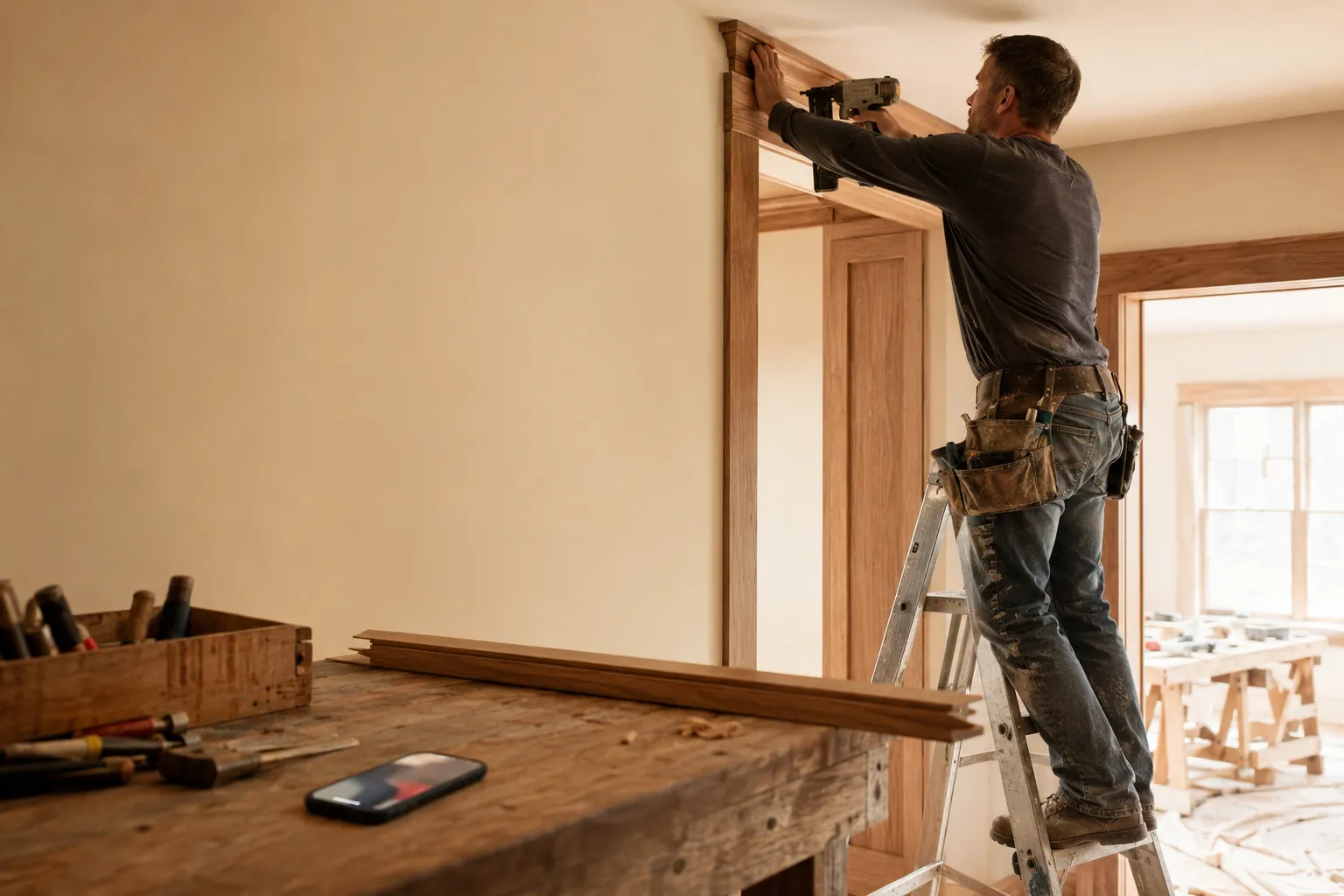
You are up a ladder hanging a door, or down on your knees scribing a baseboard. The phone goes off in your pouch. You cannot stop. So it rings out, and you tell yourself you will call back the second you are done.
By the time you climb down, the caller has booked someone else. That is the trap in one moment: not your price, not your work. You lost the job because you were busy doing a job, and there was no one else there to answer.
Why one owner is the whole problem
In a one-owner shop you are everything. The carpenter, the dispatcher, the estimator, the bookkeeper. The work that pays you needs both hands and your full head. And that is exactly when the phone rings, because that is when you are out earning.
Steve, a Californian handyman with more than twenty years on the tools, names the trap dead-on in an interview. “The one downside,” he says, “is that you have to do all the work yourself. It's hard to find people that you can trust.” That is the bind. You cannot clone yourself, and you will not hand your name to just anyone.
The cost of the missed call is just as plain. The number one mistake in this business is not answering the phone. The first one to answer usually wins the work, and you have lived the shape of it. The job goes to whoever picks up.
Why you cannot just hire your way out
The obvious move is to put a person on the phone, or a second set of hands on the tools, so you are free to answer. For a one-owner shop, that math is slow and risky.
Start with trust. Good help in the trades is hard to find, and a bad hire on a customer's house is worse than no hire at all. Then there is the wage. Caleb, who runs North Seattle Handyman and holds a general contractor license, told UpFlip, “I pay my handymen between $30 and $35 per hour ($62,400 to $72,800 per year).” That is a full salary you carry whether the week is busy or dead.
The part that stings most is that a bigger payroll is not the clean win it sounds like. Caleb found his money is not in the big crews anyway. “I have a general contractor license so that I can manage larger projects than most handyman businesses,” he says, “but I make more profit on my smaller projects.” So you can carry a full-time wage and still make your best margin on the small jobs you could have run yourself, if only the phone had not slipped past you.
First to answer takes the job
Most homeowners do not call one contractor and wait. They work down the list until someone picks up. Whoever answers first usually gets the work, and the rest never learn they were even in the running.
The pattern is well known in the trades. The first contractor to respond wins the job. Get back to a lead in the first hour and you are far more likely to turn it into real work than the owner who waits half a day. That is a direction, not a hard number, and you have already watched it play out on your own jobs.
Here is the quiet part. You cannot answer a call when you are under a crawl space. True for a crawl space, true for a ladder, true for a tile saw. We dig into the real targets in how fast to reply to leads. The short version is plain. Minutes beat hours. Seconds beat minutes. As a one-owner shop you cannot win that race alone.
And the leads you buy do not fix it
Plenty of owners try to plug the gap with paid leads from a platform. Buying more leads while you still cannot answer them is pouring water into a bucket with a hole in it. The lead you paid for rings out the same as the one you did not.
It can also be money down a hole on its own. The Federal Trade Commission went after HomeAdvisor, the company behind Angi, over exactly this. The regulator found that “while HomeAdvisor represents that services providers only will receive leads matching the types of services they provide and their preferred geographic area, many of them do not.” The case ended with $3 million refunded to contractors, in more than 110,000 checks. We weigh that trade in paid leads versus answering your own. The first fix is not more leads. It is catching the ones you already have.
Catch every lead without hiring anyone, even after hours
This is the gap SvarKlar fills. It works like an extra set of hands on your inbound, without a new person on payroll. It watches your inbound and answers the moment a lead arrives, while your hands stay on the job.
- Texts back the calls you miss. The caller you could not reach gets a real text in seconds, not a callback hours later.
- Answers texts, web forms, and direct messages 24/7. The lead from your website or a text never sits waiting for you to be free.
- Asks the right questions. What the job is, where, how big, how soon, so you are not starting from cold.
- Books the simple ones. A clear job goes on the calendar without you touching it.
- Hands you the hard ones. Anything urgent or unclear comes straight to you with the full story already gathered.
Here is what it does: SvarKlar replies to text, web-form, and message leads, and it texts back the callers you miss. It catches every lead in writing, in seconds, then either books it or hands it to you. For the wider picture, see the AI receptionist and how SvarKlar works.
Where this matters most
The calls that hurt the worst to miss are the ones that land mid-job, the exact moment this whole trap is built on. When you are up the ladder, the reply still goes out in your voice. More on that in the missed call on the job.
It also sorts the time-wasters from the real work before they reach you. Steve has a rule: “If somebody immediately mentions price on the phone, don't even waste your time.” SvarKlar can ask the qualifying questions first, so a tire-kicker gets a polite reply and a real lead gets your time. We cover that case in the price-shopper phone leads.
Built by one person, for a one-person shop
SvarKlar is not big software you fight with for six months. Fred builds it for your shop by hand and runs it himself. It is set up around how your work actually goes, the questions you ask, the jobs you book on sight, the ones you want flagged. That is the underdog version of this. One person on the hook for it, not a faceless platform that signs you up and goes quiet.
If your week looks like a phone you cannot reach and no one else to grab it, the cure is not answering faster. You are already at your limit. It is making sure the lead gets caught whether or not you are free to catch it.
Next time the phone goes off while you are up the ladder, picture the caller getting a real reply in seconds instead of a callback that comes too late. The job that was slipping past you gets caught. You finish the door, climb down, and the lead is already sorted, booked or waiting with the full story. That is the trap sprung from the other side.
Want to see how SvarKlar would catch your inbound while you work? Book a call or see how the service works.
More guides like this are collected in general contractor resources.