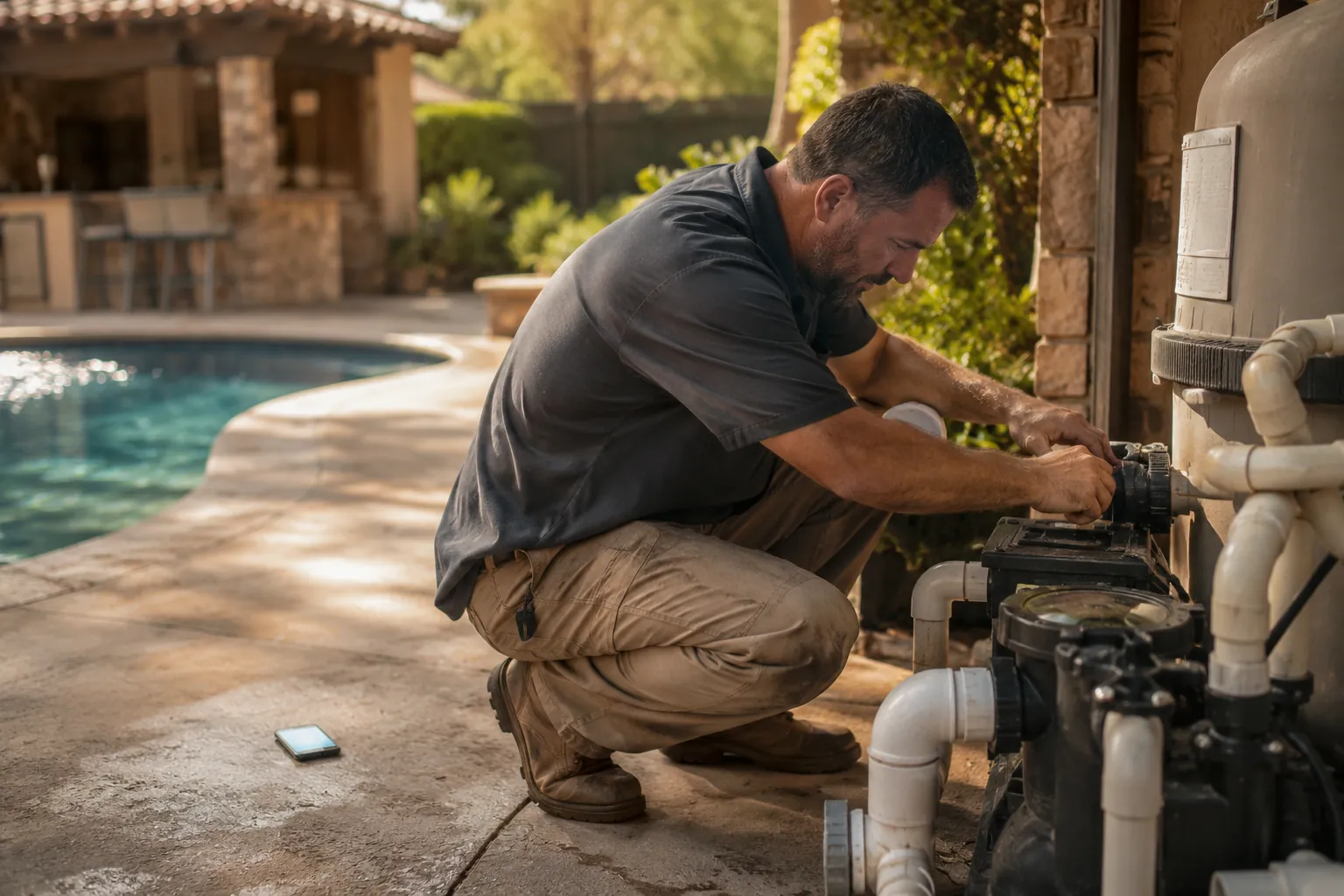
It is 1 PM and you are flat on your stomach pulling a pump motor apart. Your phone buzzes on the deck. You cannot touch it. Both hands are wet, one is holding a part that will fall in the water if you let go. The phone goes quiet. By the time you wash up, there is a voicemail and a text, and the text already says "never mind, found someone."
That is a normal Tuesday on a pool route. You cannot take calls while you are treating an algae bloom or pulling apart a pump motor. There is no front desk and no backup. It is you, the route, and a phone you cannot reach.
The call you miss is the job your competitor catches
Here is what hurts. The customer who texts you rarely waits. They text three pool guys at once and go with the first useful reply. If you are heads-down on a stop, that first reply is not yours.
Most callers who do not get through will not try you a second time. In a competitive local market they simply book with whoever picks up next. The job did not go to the better cleaner. It went to the one who answered. You have lived it.
Speed is the whole thing. We get into the real targets in how fast to reply to leads, and we put numbers on what a miss costs in the cost of missed calls. The short version: minutes beat hours, and seconds beat minutes.
Being reachable is the moat, and the route is where it cracks
Pool customers do not switch on price. Tim Ryan, who runs a pool care company in Texas, put it plainly on the Owned & Operated podcast: "people are weirdly loyal to their pool cleaners. Like they know their name, they go into their backyard." They know your name and you have a key to their gate.
So what locks a customer in? Ryan named it himself: "I think it happens naturally when you're smaller. When the customer can still call your cell phone and get ahold of you. I think it's when you start, you start losing your moat." That access is the bond. It is also the first thing to slip as the route fills up.
The thing that makes you hard to beat is that people can reach you. And the route is exactly where that breaks. A full day of stops, hands in the water, phone on the deck. The bond that protects your business is the same bond a full day of pump work quietly cuts. You do not lose the moat by getting worse. You lose it by being unreachable. More on that in why being reachable is the moat.
Voicemail does not save the lead. It buries it.
You might think voicemail catches what you miss. It does not, and the people on the other end know it. Every homeowner ends up asking the same thing. Why does no one ever return a call or a voicemail?
A pool pro who writes as Swimming Pool Steve says the quiet part out loud, from the pro's side: "If you left that message on a busy day that is a guaranteed delete on my end." That is not a bad operator. That is a busy one at the end of a route who cannot face a pile of vague voicemails.
And it gets worse in season. In the peak months the call volume runs past what one person can work through. One person cannot do the route and clear a full voicemail box on the same day. Something gives, and it is usually the phone. We dig into why voicemail is the wrong net in the voicemail guaranteed-delete problem.
What to set up instead
The fix is not answering the phone more. You already cannot. The fix is making sure every lead gets a fast, useful reply whether or not your hands are free.
That means a responder that works while you work. When a text, a web form, or a direct message comes in, it answers in seconds. When a caller hits voicemail, it texts them right back before they move on. It does the part a sharp front desk would do for a pool route, in this order:
- Answers the inbound. Texts, website leads, and direct messages, all of them, all day. Miss a call, and it texts that caller back right away.
- Asks your real questions. The address, the pool problem, the equipment, how soon they need you. So you are not starting from zero.
- Books or sets a callback. It puts the stop on the calendar or locks a clear time you will call.
- Flags the urgent ones. A green pool before a weekend party or a dead pump goes straight to you with the facts, not a shrug.
The urgent calls are the ones you cannot afford to let sit. A route gets every kind of call: pump failures, leaks, and green pools, plus routine scheduling and new business. A homeowner with a green pool the day before a holiday party is not going to wait for a callback. A green-to-clean job is real money too, worth far more than a single routine stop. Catch it fast and it is yours. More on that in handling green-pool emergencies.
What about paying for leads instead?
Some owners figure the answer is to buy more leads from a platform. Think it through first. A bought lead is shared, so you are racing several other companies to the phone, and you pay for it whether or not you win it. If you are on a route and slow to answer, that paid lead is just a faster way to lose money. The cheaper move is to catch the leads you already earn. We lay out the trade in paid leads versus answering the ones you have.
Will it sound like a robot and cost me the job?
Fair worry. You should have it. A cheap bot that botches an address or guesses a price on a pool it has never seen can do more damage than a missed call. That is a real risk, not a sales line.
So the setup matters more than the software. A good responder replies in your voice, asks the questions a pool route actually needs, and knows when to stop guessing. Anything urgent or unclear goes to you, the owner, with the full context. It should never promise a tech this afternoon if that is not true. Consistency and communication are what win in home service, and a responder is how a one-person route keeps both up without working the phone all night.
How SvarKlar fits a pool route
SvarKlar is the receptionist for your inbound. It replies to texts, web forms, and direct messages in seconds, around the clock, and it texts back the callers you miss. It qualifies the job, books it, and sends you a clean handoff. Urgent or unclear? That one goes to you with the full picture, so you are never the slow one on a green-pool call.
The way it works is simple. It handles everything in writing, and it handles it fast. It texts back the callers you miss within seconds, and it answers your text and web leads around the clock. That is exactly the part that was slipping through while your hands were in the pump.
And it is built by hand, not bought off a shelf. Fred sets it up for your route himself and runs it, tuned to your questions, your booking, the jobs you want flagged. No big-software onboarding, no per-tech bill, no contract you cannot get out of. One person on the hook for it, not a platform that signs you up and disappears. If you want the longer tour, see how an AI receptionist works for service businesses and how SvarKlar works.
The next lead that texts you while your hands are in the pump does not have to walk. A responder that answers in seconds catches it, asks your questions, and books it before the homeowner texts the next pool guy. You keep working. The job still books with you.
Want to see how it would handle your inbound on a busy route day? Book a call or see how the service works.
More guides like this are collected in our pool service resource hub.